> ## Documentation Index
> Fetch the complete documentation index at: https://help.dingtalk.io/llms.txt
> Use this file to discover all available pages before exploring further.
# Overview
> Overview of DingTalk attendance group settings: attendance group owners can create attendance groups and configure rules such as shifts and clock-in methods directly in DingTalk. Once set up, employees can start clocking in.
## 1. Feature overview
Attendance group owners can configure attendance rules directly in DingTalk. Once configured, employees can start clocking in.
## 2. Use cases
Scenarios where the attendance group owner configures attendance groups, attendance types, clock-in methods, attendance schedules, overtime rules, and more for employees.
## 3. Operation path
### Mobile
Open Mobile DingTalk > Workbench > Attendance > Settings > Add attendance group, then set the attendance members and attendance group name as needed.

Set the attendance type to Fixed working hours, Shift-based working hours, or Flexible working hours.
Shift-based working hours support automatic shift matching. After clock-in, the system automatically matches the shift, and admins can flexibly verify and edit the records. Matching is precise, which eliminates inefficient manual scheduling.
**⚠️ Notes:**
**Attendance type settings**
1. Fixed working hours: applies when everyone clocks in at the same time, such as office workers on a 9-to-5 schedule.
2. Shift-based working hours: applies when different employees clock in based on their own schedules, such as factory, store, or multi-shift workers.
3. Flexible working hours: applies when clock-in and clock-out times are flexible and employees can clock in at any time, such as sales staff or hourly workers.
**Automatic shift matching when no shift is scheduled: makes shift rotation and swaps more flexible.**
1. The system automatically matches the closest shift based on the employee's clock-in time.
2. Same-day shifts are matched in real time, and admins can verify and edit them the next day.
3. When shifts are added to or removed from the attendance group, shifts included in automatic shift matching by default are updated automatically.

Clock-in methods support location-based clock-in, Wi-Fi clock-in, and Time Clock clock-in.

Tap More settings to configure overtime rules, makeup clock-in rules, field clock-in rules, and more.
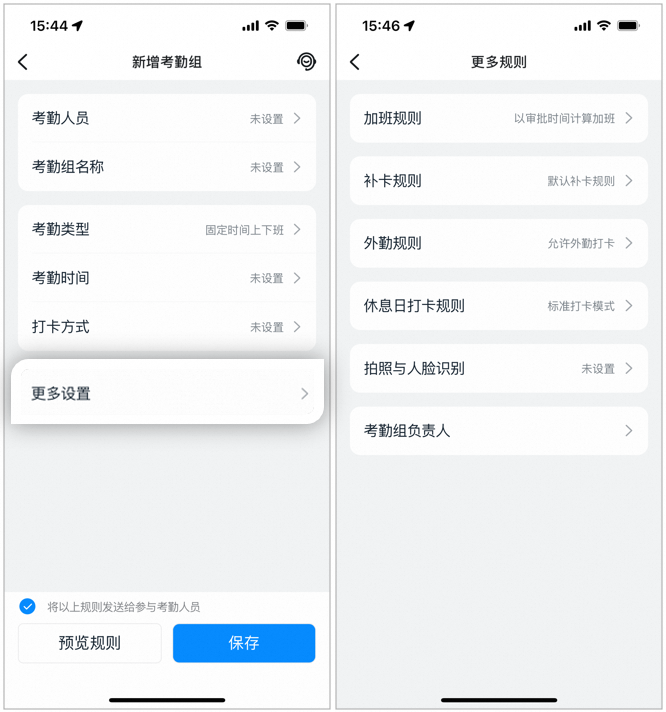
In the photo verification rules, you can manage employee facial data.
**⚠️ Notes:**
Facial clock-in has been upgraded. Photos are no longer archived.

### Desktop
#### 1. Set up an attendance group
Open Desktop DingTalk > Workbench > Attendance > Attendance group management > Add attendance group.

Enter the attendance group name and select attendance members as needed.

#### 2. Set the attendance group owner
**⚠️ Notes:**
1. Primary owner (by default, the attendance group creator): has permission to delete the attendance group and add sub-owners.
2. Sub-owner permissions: the primary owner can configure management permissions for sub-owners.

Set the attendance schedule: fixed shift attendance, shift-based attendance, and flexible working hours are all supported. Shifts are configured in shift management. For details, see [**Shift management**](/attendance/shift-management).
**⚠️ Notes:**
1. Fixed shift attendance (fixed working hours): everyone in the attendance group clocks in at the same time. Suitable for office workers, for example a 9-to-5 schedule.
2. Shift-based attendance (shift-based working hours): a custom shift is set for each person. Suitable for factories and stores, for example a three-shift rotation.
3. Flexible working hours: clock-in and clock-out times are flexible and employees can clock in at any time. Suitable for sales staff and hourly workers such as decorators and housekeepers.

For shift-based attendance, you can enable automatic shift matching when no shift is scheduled. The system automatically matches the shift after clock-in.
**⚠️ Notes:**
Automatic shift matching makes shift rotation and swaps more flexible:
1. The system automatically matches the closest shift based on the employee's clock-in time.
2. Same-day shifts are matched in real time, and admins can verify and edit them the next day.
3. When shifts are added to or removed from the attendance group, shifts included in automatic shift matching by default are updated automatically.
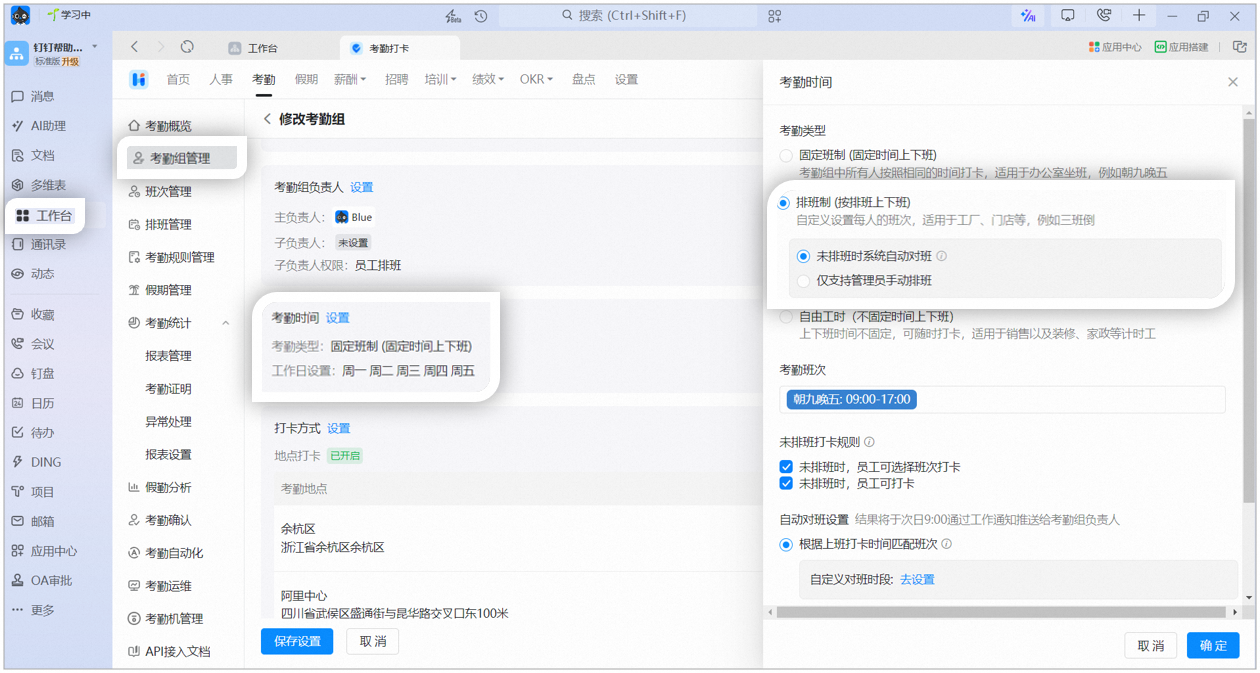
Set the clock-in method: choose from location-based clock-in, Wi-Fi clock-in, or Time Clock clock-in.

Set overtime rules: add a new overtime rule or edit an existing one.

Set field clock-in rules: enable field clock-in and configure whether approval is required, the approval method, whether an alias must be entered, and more.
**⚠️ Notes:**
1. Allow employees to hide the detailed address: hides the address for remote work to protect employee privacy.
2. Allow office clock-ins to update field clock-ins for check-in: when both an office clock-in and a field clock-in exist within the check-in time range, the earlier office clock-in is used as the check-in. Suitable for companies or teams that require employees to work in the office. If employees often leave for external work before returning to the office, we recommend disabling this option.
3. Allow field clock-ins to update office clock-ins for check-out: when both an office clock-in and a field clock-in exist within the check-out time range, the later field clock-in is used as the check-out. Suitable for companies or teams where employees work overtime outside the office and need to update the check-out time.
4. Allow location fine-tuning: when employees travel to visit clients, they can select a designated location within the configured range.

Set rest day clock-in rules: configure the rest day clock-in start time, clock-in method, and whether approval is required.
**⚠️ Notes:**
**Rest day clock-in methods:**
1. Standard clock-in mode: the first clock-in counts as check-in and the second as check-out. Any subsequent clock-ins update the check-out time.
2. Strict clock-in mode: the first clock-in counts as check-in, the second as check-out, the third as check-in, and so on in alternation.
**Approval required for rest day clock-ins:**
Employees must submit an \[Overtime], \[Leave for business], or \[Business trip] request. Clock-in is only allowed after the request is approved.

Set makeup clock-in rules: add new makeup clock-in rules, edit selected makeup clock-in rules, and configure the approval template for makeup clock-in requests.
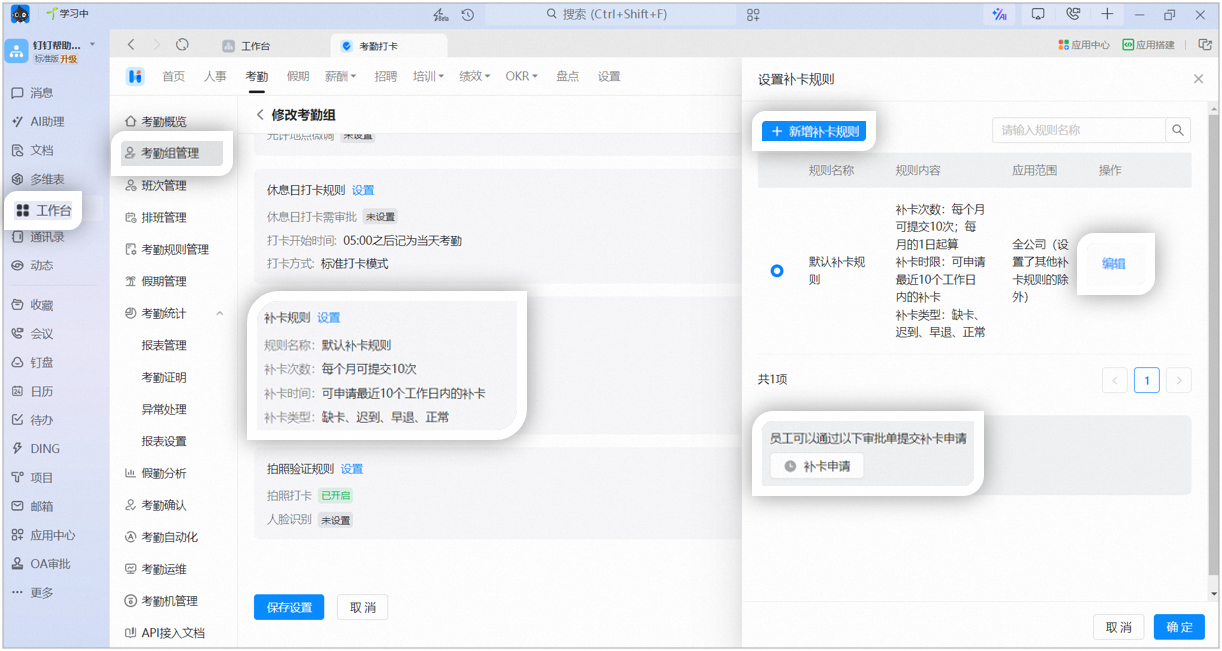
Set photo verification rules: enable photo clock-in, facial recognition, or liveness verification. Scan the QR code with Mobile DingTalk to manage facial data enrollment. Finally, click Save settings to complete the attendance group setup.
**⚠️ Notes:**
1. Photo clock-in: employees must take a photo when clocking in, and photos are archived.
2. Facial recognition: employees' faces are verified automatically when clocking in, and photos are not archived.
