Additional attendance rules, including the attendance Allowlist, clock-in rules outside the attendance group, leave-related rules, half-day duration definitions, and photo approval clock-in. Configure all of these on the desktop client under Attendance Rules Management > Other Rules.
The Other Rules section centrally manages the Allowlist, clock-in outside the attendance group, leave rules, half-day duration definitions, and photo approval clock-in. These settings can only be configured on the desktop client. Path: Desktop DingTalk > Workbench > Attendance > Attendance > Attendance Rules Management > Other Rules.
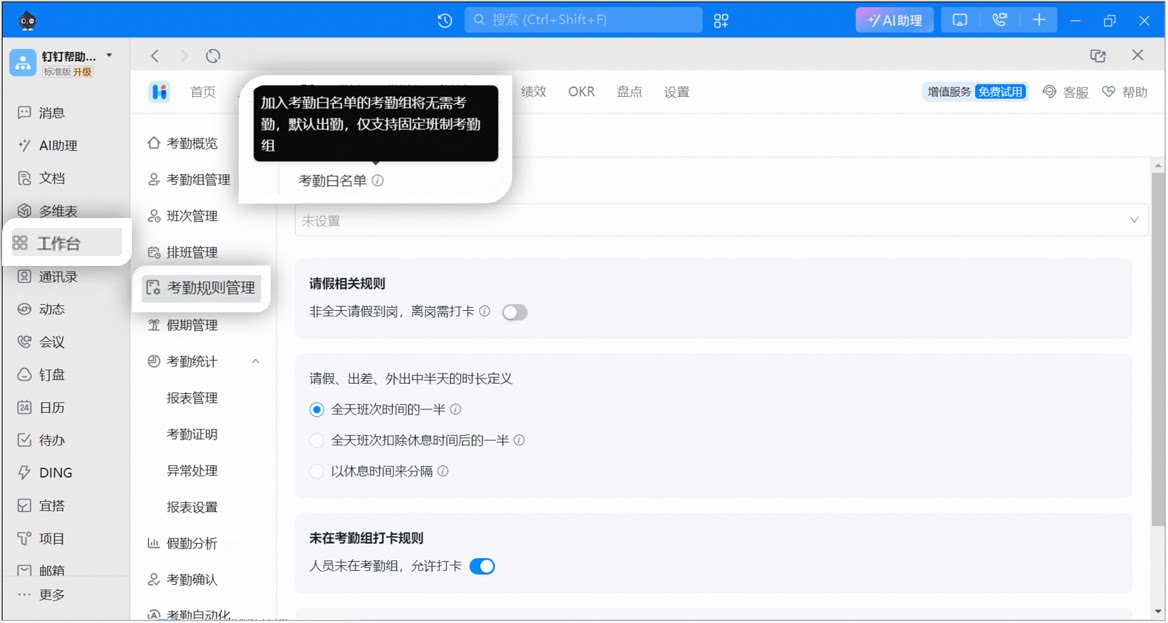
Attendance Allowlist
Overview: Senior executives in the Organization are marked as present by default, and overtime or leave requests are calculated based on shift times.Use case: The Organization has Users who do not need to record attendance and should be marked as present by default.
Attendance groups added to the Allowlist do not require attendance and are marked as present by default. Only fixed shift attendance groups are supported.
Example steps for setting up the attendance Allowlist
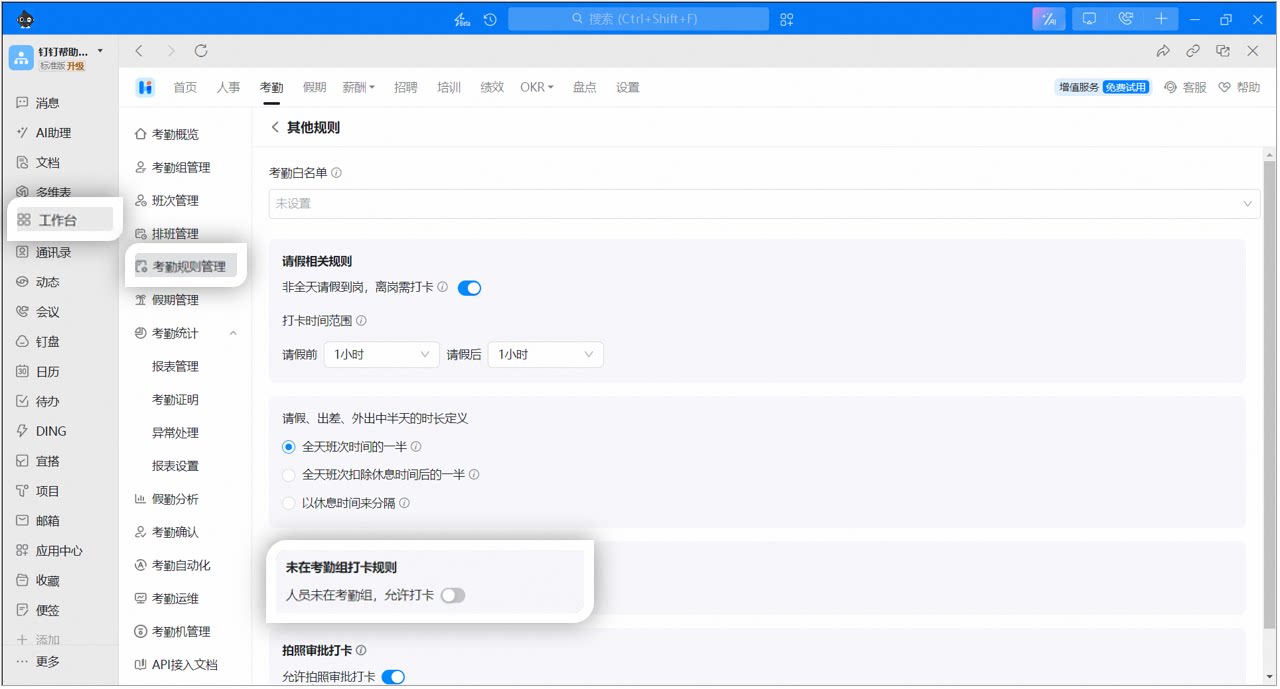
Clock-in rules outside the attendance group
Overview: When enabled, Users who are not in any attendance group can also clock in.Use case: The Organization has Users without fixed working hours who still need to record their working hours.Admins can decide whether Users outside an attendance group are allowed to clock in:
On: Users can clock in, and attendance is calculated based on flexible working hours.
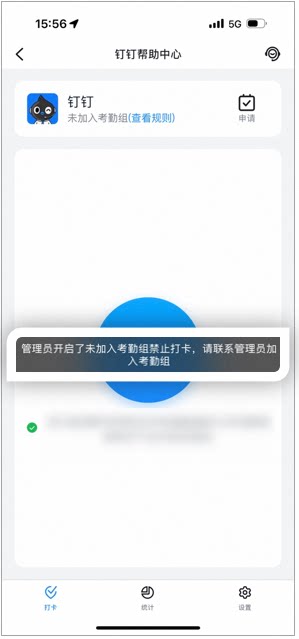
Close: Users outside an attendance group cannot clock in. When they tap to clock in, the Page displays: “The Admin has restricted clock-in for Users not in an attendance group. Please contact the Admin to join an attendance group.”
Set clock-in rules outside the attendance group
Example of the Employee clock-in Page when the option is closed
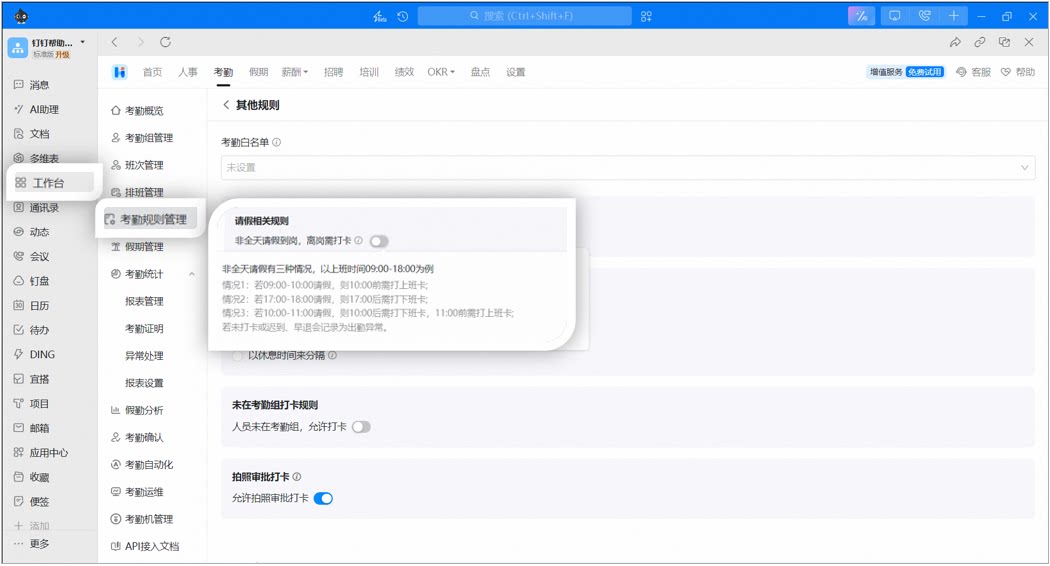
Leave-related rules
Overview: For leave requests that do not cover the full day, Admins can decide whether clock-in is required when leaving or returning, and can set the allowed clock-in time range before and after the leave.Use case: When Users take non-full-day leave, this helps Admins track their working hours accurately.Non-full-day leave falls into three scenarios. Take a 09:00–18:00 shift as an example:
If leave runs from 09:00 to 10:00, clock-in for start of work must be completed before 10:00.
If leave runs from 17:00 to 18:00, clock-out must be completed after 17:00.
If leave runs from 10:00 to 11:00, clock-out must be completed after 10:00 and clock-in must be completed before 11:00.
Missed clock-ins, late arrivals, and early leaves are recorded as attendance errors.
Example steps for setting up leave-related rules
Half-day duration for leave, business trip, and out-of-office
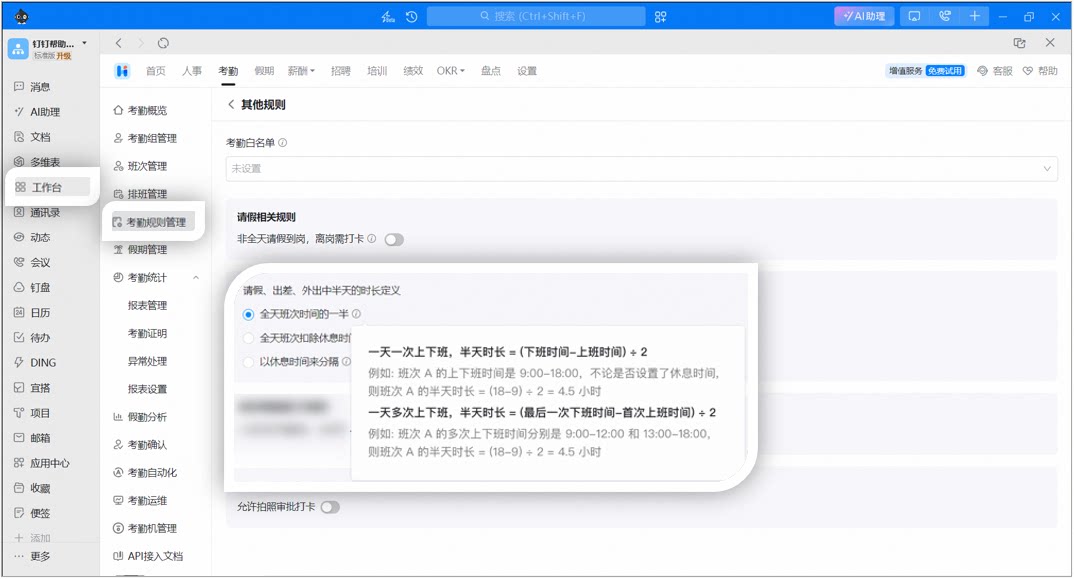
Overview: The half-day duration can be defined in three ways: half of the full-day shift time, half of the full-day shift time excluding breaks, or split by break time.Use case: Organizations can adjust the half-day duration based on actual working hours.
Half of the full-day shift time
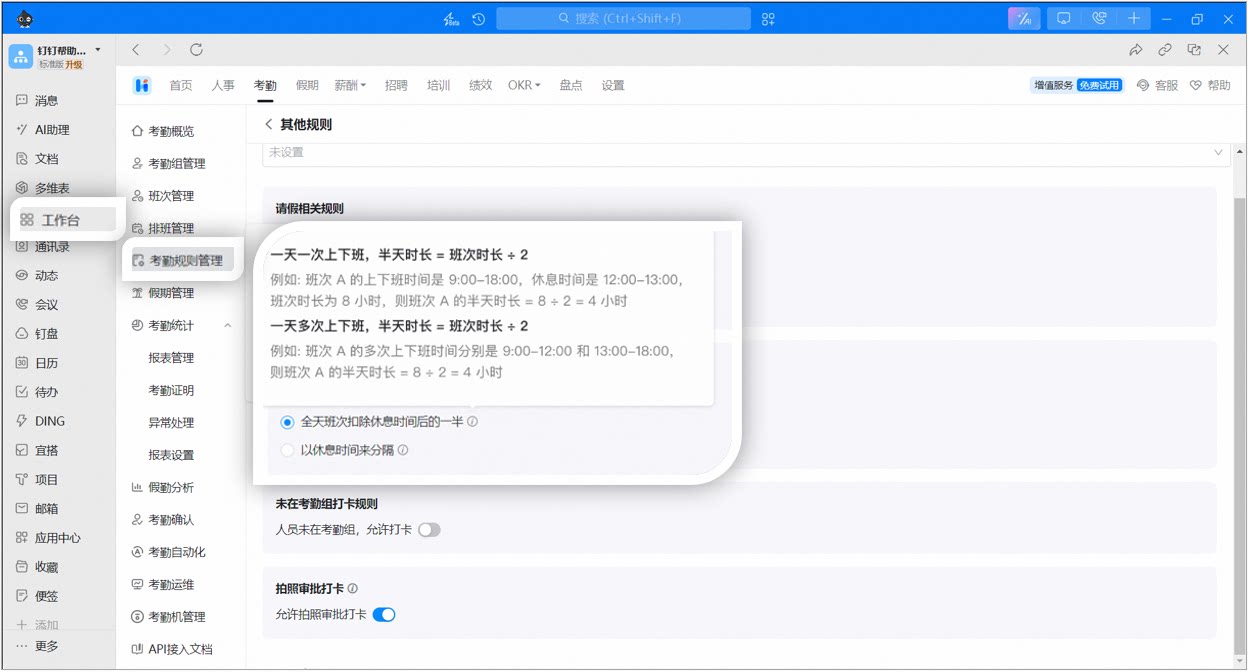
Half of the shift time excluding breaks
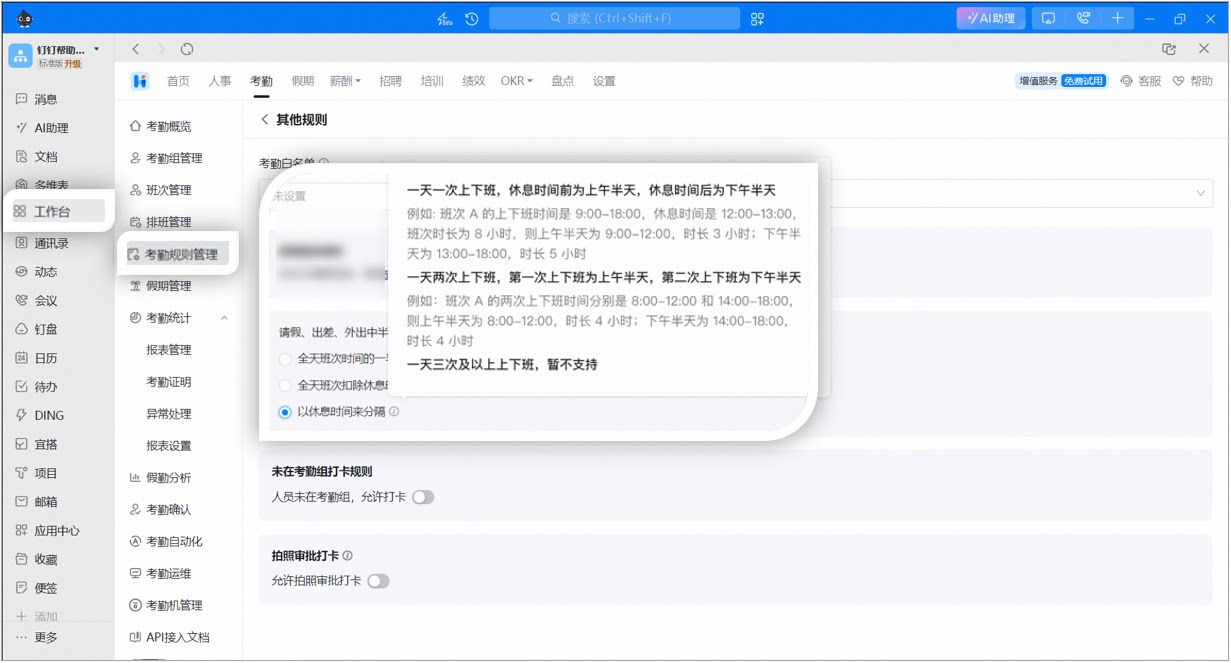
Split by break time
One clock-in/out per day: Half-day duration = (End time − Start time) ÷ 2. For example, shift A runs 9:00–18:00. Regardless of break time, the half-day duration = (18 − 9) ÷ 2 = 4.5 hours.
Multiple clock-ins/outs per day: Half-day duration = (Last end time − First start time) ÷ 2. For example, shift A has clock-in/out periods of 9:00–12:00 and 13:00–18:00, so the half-day duration = (18 − 9) ÷ 2 = 4.5 hours.
Half of the full-day shift time
One clock-in/out per day: Half-day duration = Shift duration ÷ 2. For example, shift A runs 9:00–18:00 with a break from 12:00–13:00. The shift duration is 8 hours, so the half-day duration = 8 ÷ 2 = 4 hours.
Multiple clock-ins/outs per day: Half-day duration = Shift duration ÷ 2. For example, shift A has clock-in/out periods of 9:00–12:00 and 13:00–18:00, so the half-day duration = 8 ÷ 2 = 4 hours.
Half of the shift time excluding breaks
One clock-in/out per day: The time before the break is the morning half-day, and the time after the break is the afternoon half-day. For example, shift A runs 9:00–18:00 with a break from 12:00–13:00. The morning half-day is 9:00–12:00 (3 hours), and the afternoon half-day is 13:00–18:00 (5 hours).
Two clock-ins/outs per day: The first clock-in/out period is the morning half-day, and the second is the afternoon half-day. For example, shift A has two clock-in/out periods of 8:00–12:00 and 14:00–18:00, so the morning half-day is 4 hours and the afternoon half-day is 4 hours.
Three or more clock-ins/outs per day: Not supported.
Split by break time
Photo approval clock-in
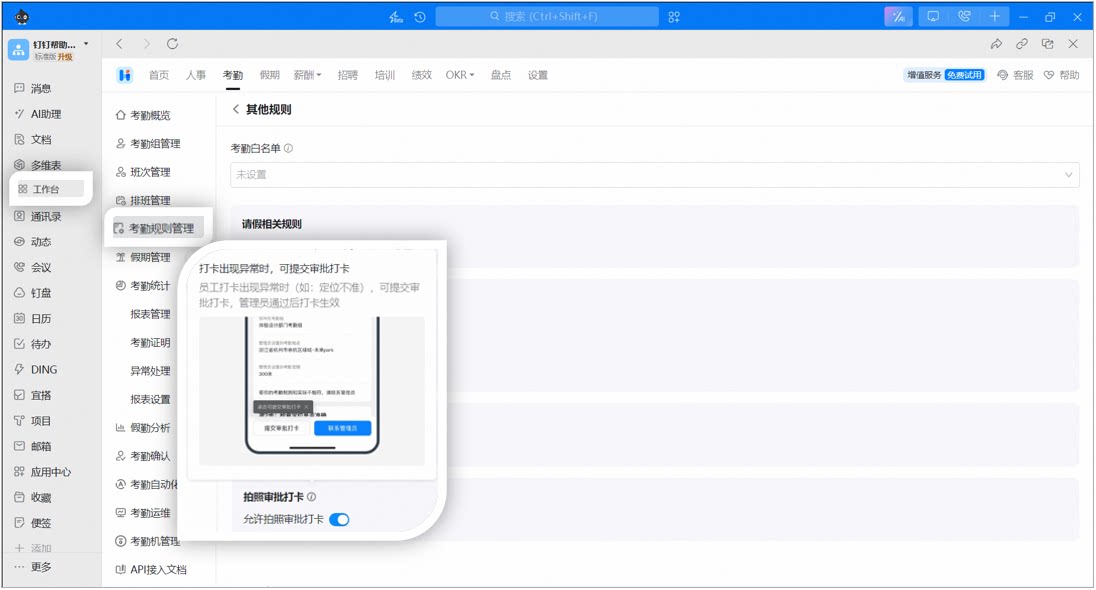
Overview: When Employees encounter an error during clock-in, they can submit a photo approval clock-in.Use case: The Organization’s attendance Location is underground, has poor network coverage, or similar scenarios.
Once enabled, Employees can submit a photo approval clock-in when an error occurs (for example, inaccurate positioning). The clock-in takes effect after the Admin approves it.
Example steps for setting up photo approval clock-in


 Chats
Chats Calendar
 Meetings
 Contacts
 Mail
Mail Docs
Docs Drive
Drive AI Table
 AI Minutes
 Attendance
 Approval
 YiDA
YiDA Admin Console