

 Chats
Chats Calendar
 Meetings
 Contacts
 Mail
Mail Docs
Docs Drive
Drive AI Table
 AI Minutes
 Attendance
 Approval
 YiDA
YiDA Admin Console
Database
Only the PostgreSQL database is currently supported. PostgreSQL v14 or later is recommended. The specific configuration requirements are as follows:Object Storage
Object storage supports three options: Alibaba Cloud OSS, Huawei Cloud OBS, and Inspur Cloud OSS.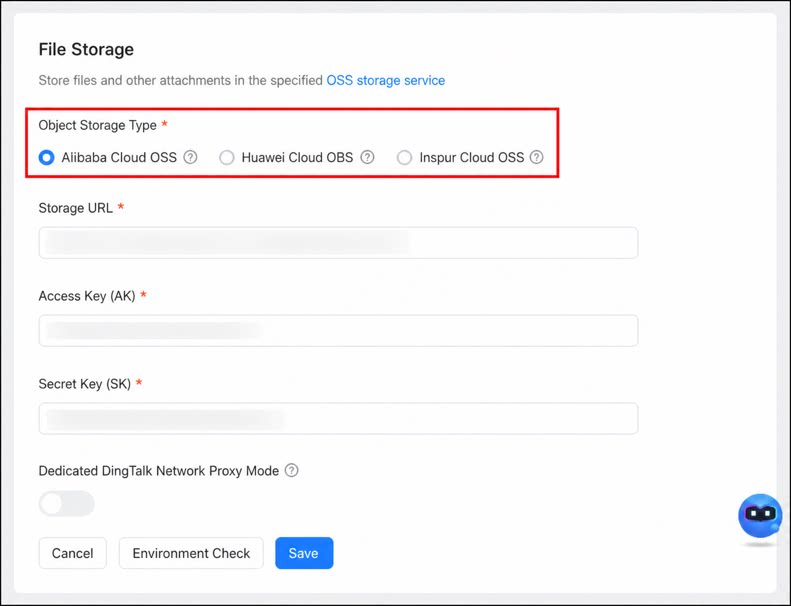
IT Resources: Storage Preparation
Local database- PostgreSQL database v14 or later.
- Publicly accessible database domain, database name, account, and password.
- Recommended server: 8-core 16G, 2T disk.
- Publicly accessible OSS bucket domain, access key (AK), and secret key (SK).
| Solution overview | Advantages | Applicable scenarios | |
| Database | Solution 1: Dedicated cloud database | Delivers the high availability of a cloud database with multi-region redundancy and supports elastic auto-scaling. The YiDA platform is responsible for maintaining full cloud computing and cloud storage reliability. | Lets customers independently view and maintain the database for operational auditing. Suitable for storing business data on an independent cloud storage server, separated from YiDA’s public cloud business storage. |
| Solution 2: On-premises IDC data center | Meets specific organization requirements by enabling local data center deployment and storage. | Suitable for organizations with specific data storage requirements whose business data fields cannot be stored in the cloud. Requires an in-house DBA team capable of maintaining the environment, with database primary-standby failover and physical disaster recovery in place. | |
| Object storage OSS | Solution 1: Cloud OSS service | Delivers full file storage services with multi-region redundancy for high availability, and supports elastic auto-scaling. | Suitable for storing business data on an independent cloud storage server, separated from YiDA’s public cloud business storage. |
| Solution 2: On-premises OSS solution | Combined with private YiDA cluster deployment to meet specific organization security requirements, enabling local data center deployment and storage. | Suitable for organizations with specific data storage requirements whose business data fields cannot be stored in the cloud. Requires an in-house DBA team capable of maintaining the environment, with database primary-standby failover and physical disaster recovery in place. | |
| Data analytics | Solution 1: Cloud-based big data analytics | Supports large-cluster data analytics. Intermediate data requires cloud storage for temporary staging. | Suitable for using cloud-based visual big data capabilities such as table association, table filtering, and data visualization. |
| Solution 2: On-premises database and data lake with local BI analytics | Provides all raw business database fields and data models across every dimension. | Suitable for organizations with a professional BI team that can perform data analytics directly against the local IDC using tools such as Tableau or Typhoon. |